



Federal Tax Brackets & Capital Gains Rates
Understand how federal income tax brackets and long-term capital gains rates generally work. The information below is designed to help investors quickly reference the 2026 federal tax bracket tables and better understand why a higher bracket does not mean all income is taxed at that higher rate.
Income Tax Brackets
Federal income taxes are progressive. This means only the portion of taxable income that falls within each bracket is taxed at that bracket rate. Moving into a higher tax bracket does not mean all taxable income is taxed at the higher rate.
2026 Income Tax Rates
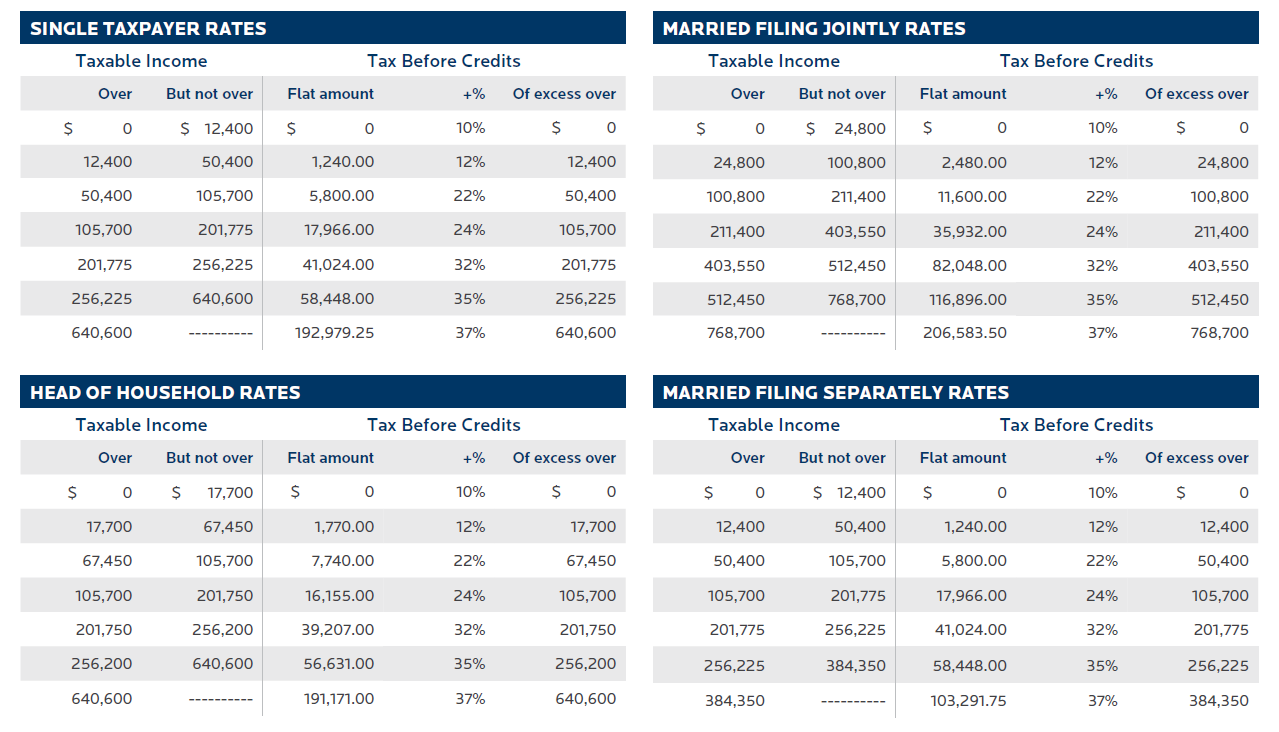
Source visual excerpt: Quick View Tax Guide 2025-2026, 2026 Income and Payroll Tax Rates.
Quick Example
If a married couple has taxable income that reaches the 24% bracket, only the portion of taxable income within the 24% range is taxed at 24%. Earlier layers are taxed at the lower rates shown in the table.
Long-Term Capital Gains Rates
Investments held for more than one year generally receive preferential federal tax treatment. Depending on taxable income and filing status, long-term capital gains and most qualified corporate dividends may be taxed at 0%, 15%, or 20%.

Source visual excerpt: Quick View Tax Guide 2025-2026, Capital Gains and Dividends.
Disclosure
Securities and advisory services offered through LPL Financial, a registered investment advisor. Member FINRA/SIPC.
The opinions voiced in this material are for general information only and are not intended to provide specific advice or recommendations for any individual. No strategy assures success or protects against loss. This information is not intended to be a substitute for specific individualized tax or legal advice. We suggest that you discuss your specific situation with a qualified tax or legal advisor.